

,Have you ever tried to make a classic whiskey sour or elegant Pisco sour at home using a cocktail shaker , only to find that the foam on top of the drink is always thin and disappears quickly, completely failing to achieve the thick, creamy, cloud-like texture of the drink in a bar?
.The problem isn’t your recipe but your technique for shaking the cocktail shaker .

a common mistake when swirling your final drink in your glass.
.Traditional wet shaking is good at cooling and diluting the liquor, but it hinders the formation of foam in a cocktail shaker .
H3. Why do ice cubes destroy foam?
Egg whites are mainly composed of water and protein. To form stable foam, you need to complete two key steps:
.Protein denaturation: Protein molecules are forced to unfold due to the violent mechanical motion (shaking) in a cocktail shaker .
Air intrusion: The unfolded protein molecules act like a tiny net, capturing and enveloping the intruding air.
The interference from ice lies in temperature: low temperatures cause protein molecules to contract, inhibiting their ability to fully expand and trap air. Therefore, if you add ice from the beginning, the foam will become thin and unstable due to insufficient protein activity.
—isThis is why “dry shaking”—in a cocktail shaker —is a crucial step that allows proteins to fully expand and freely mix with air at room temperature.
Mastering professional techniques: Three-stage shaking creates perfect texture
.To ensure the cocktail is thoroughly chilled (for the taste) while maintaining the best foam (for texture), professional bartenders typically break down the preparation process into three steps, perfectly balancing science and art, all done using your cocktail shaker .
—TheStep 1: Dry Shaking – The Foundation of Foam This is a pure air-incorporation stage designed to break up and activate proteins to the maximum extent.
up as manyObjective: To incorporate as much air and break up proteins as possible without diluting or cooling the wine.
Shaking glass selection: Both Boston cocktail shakers and Kobler cocktail shakers are acceptable, but Boston cocktail shakers have a larger internal space, resulting in higher air mixing efficiency.
Operating steps:
.Add all ingredients (including spirits, acidulant, syrup, and egg white) to the cocktail shaker .
Key point: No ice!
Seal the cocktail shaker and shake it vigorously and forcefully.
,Duration: Shake for 15 to 20 seconds. You will feel the cocktail inside the shaker warming up and even becoming slightly pressurized. You should hear the liquid being vigorously shaken in the shaker , rather than the crackling of ice cubes hitting each other.
—CoolingStep 2: Wet Shake — Cooling and Dilution
Now, we use a cocktail shaker to bring the beverage to the perfect drinking temperature and dilution.
Objective: To cool the cocktail to below 0°C and achieve flavor balance.
Operating steps:
.Open the cocktail shaker .
Add plenty of fresh, hard ice (the more ice, the slower the dilution and the faster the cooling).
Reseal the cocktail shaker and shake as usual.
Duration: Shake for about 10 to 15 seconds, until you see frost begin to form on the metal exterior of the cocktail shaker.
Step 3: Double Strain—A perfect double strain is an essential step in any professional cocktail, ensuring the smoothness of the final product.
Objective: To filter out tiny ice crystals, fruit pulp, or any lumps of unwhipped egg white.
How to operate:
First, use a Hawthorne filter placed on the cocktail shaker for initial coarse filtration.
Then filter it a second time through a fine mesh strainer and pour it directly into a cocktail glass.
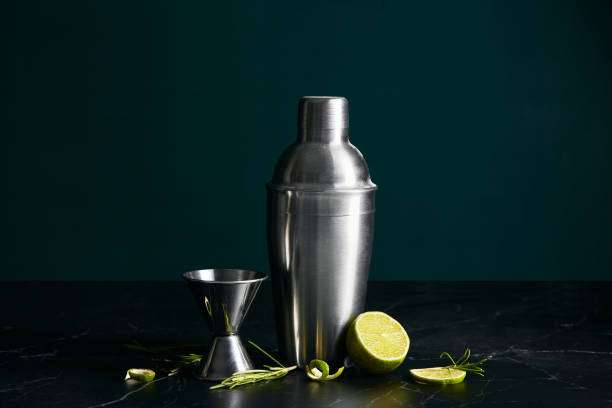
Summarize:
Once you master the magic of dry shaking, your cocktail shaker will no longer be a simple mixing tool but a work of art that can transform ordinary liquor into something with a velvety texture.
Now, it’s time to put this technique to the test at your bar. Which cocktail do you enjoy making with this technique the most? Tell me in the comments which sour drink you think best showcases the allure of a perfect foam!
Frequently Asked Questions and Advanced Techniques
Q1: What if my foam is still not thick enough? (Ultimate Tip)
It’s possible the dry shake wasn’t thorough enough, or your egg white ratio was insufficient. First, perform a wet shake (to cool and dilute), then strain out the liquid and foam. Pour the liquid into a glass, pouring only the foam back into the empty cocktail shaker, and then perform a second dry shake without ice.
Q2: How to remove the “fishy smell” of egg whites?
Acidity is key: Make sure to use freshly squeezed lemon or lime juice. Acidity is the most effective way to eliminate the fishy smell of egg whites.
Add a few drops of bitters before shaking, such as Angostura. The spices and flavor oils in the bitters can perfectly mask and balance the taste of the egg whites.
Q3: How do I create foam without using egg whites?
Vegan alternatives:
Use the liquid from canned chickpeas (aquafaba). This liquid contains natural proteins and starches, and its foaming effect is almost identical to that of egg whites.
Shake well with a cocktail shaker before use.