A cocktail shaker for the first time, many people only focus on two things: how good it looks and how heavy it is.
But after using it for a while, they will find that what determines the lifespan of a cocktail shaker is never its appearance, but those “inconspicuous details.”
When I first practiced bartending at home, I encountered a very typical situation: the cocktail shaker was shaken perfectly, but the glass was stuck, and I couldn’t unscrew it no matter what I did.
In the end, I had to rinse it with hot water, and it even left a deformed mark. It was only after that that I truly began to investigate: what exactly is wrong with a cocktail shaker?
In this article, we will break down the parts of a cocktail shaker that are most prone to problems from a practical usage perspective.
Interface part: The part of the cocktail shaker where “the problem first occurs”
If I could only choose one “high-risk area,” it would definitely be the interface between the cup body and the lid.
Why are interfaces so prone to failure?
The reason is simple but often overlooked:
Frequently, with alternating hot and cold temperatures, a large amount of ice is added, which quickly cools the metal; during cleaning, it is rinsed with hot water, causing the metal to repeatedly expand and contract with the temperature changes.
The force is concentrated on opening, closing, rotating, and striking; all operations are concentrated at the interface.
High sealing precision is required; even slight deformation can cause the following:
Leaking wine
Stuck
Loose
In my own experience, 80% of the problems with cocktail shakers that “break down” are with the interface, not the shaker itself.
Common problems
It feels like it’s not “locked” tightly when I try to tighten it.
Slight water seepage when shaken.
It loosens with a strong shake.
After using it for a while, the lid became increasingly difficult to open.
If you notice these signs, you can be fairly certain that the interface has started to deform or wear out.
zone.”The edge of the cup lid: the most easily overlooked “fatigue zone”.
Many people only look at whether the lid is tight but ignore the thickness and craftsmanship of the lid’s edge.
Why are edges prone to damage?
The edge is usually the thinnest part.
It is often tapped when it is opened and closed (many people are used to lightly tapping the table).
Stresses in different directions are repeatedly superimposed.
I used to have a cocktail shaker. The lid seemed fine, but every time I shook it and poured the drink, a drop would always run down the rim.
Later I discovered that the rim had developed a very subtle deformation, almost invisible to the naked eye.
Real user experience
New cup: Smooth fit.
After six months of use, the edges started to feel rough.
Continued use: Sealing performance significantly decreased.
This is why a cocktail shaker that seems “still usable” is actually on the verge of being scrapped.
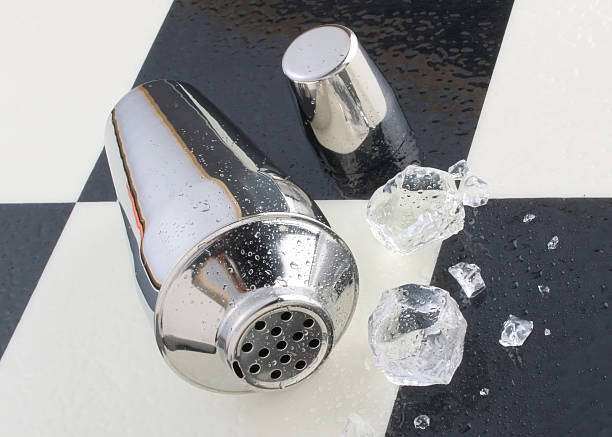
a cocktail shaker with an ice filter; the ice filter holes and the filter screen are among the most structurally vulnerable parts.
Common damage methods
The edges of the filter pores were repeatedly impacted by ice, gradually deforming.
Using too much force with the brush during cleaning caused the aperture to enlarge.
Loose welds on the filter screen (especially in lower-priced models).
I’ve encountered this myself: the filter holes were originally very uniform, but after a long time they became uneven in size, and the flow rate of the wine became very strange when pouring, and it might even mix in ice fragments.
These types of problems don’t “suddenly break down,” but rather gradually affect the user experience.
Bottom of the cup: Not broken from a fall, but due to “hidden fatigue.”
Many people think that as long as the cup body is not dented, it is fine, but in fact, the bottom of the cup is another area that bears pressure for a long time.
Why does the bottom of the cup become a potential hazard?
When swirling the drink, the ice cubes constantly hit the bottom of the glass.
When placed, the bottom of the cup bears the entire weight.
Some people will tap the bottom forcefully to “separate the lid.”
Over time, the following may occur:
The bottom of the cup bulged slightly.
It’s unstable when placed on the table.
The feel is abnormal when shaken.
All of this indicates that the cocktail shaker has entered a stage of structural fatigue.
Interior wall coating (if applicable): Most easily “ruined by cleaning.”
Some cocktail shakers have internal treatments, such as brushed or special coatings. While these designs improve the feel, they also introduce risks.
Cocktail shakers are always hand-washed and never put in the dishwasher.
This makes a very noticeable difference in extending the product’s lifespan.
What usage habits can accelerate the damage to a cocktail shaker?
Here are a few very “common” bad habits that are really harmful to your health:
Knock hard on the table to open the lid.
Pour hot water into the cup immediately after it has cooled down.
Tighten the connectors before shaking if they are not aligned.
Ice can be stored for a long time without emptying.
Clean with a stiff brush and steel wool.
These behaviors may not show up in the short term, but they will all become apparent after six months.
FAQ:
Q1: How long is normal for a cocktail shaker to last?
A: With proper home use and maintenance, it should last 2-3 years without problems; for high-frequency use, the condition of the interface should be checked.
Q2: Can I still use a stuck cocktail shaker?
A: It’s okay if it happens occasionally, but if it freezes frequently, it means the interface is deformed, and it’s not recommended to continue using it.
Q3: Are cheaper cocktail shakers more prone to breaking?
A: Price isn’t the only factor, but lower-priced models often compromise on interface technology and wall thickness.
Q4: Does a leaking bottle necessarily require replacement?
A: Yes. A leak indicates a failure in the sealing structure, affecting both safety and the user experience.
Q5: How do I know if my cocktail shaker is “time to retire”?
A: If it leaks, jams, shakes abnormally, or is unstable, it’s worth replacing.
Summarize:
A cocktail shaker is not a disposable tool; its damage almost never happens suddenly but rather accumulates quietly with each shake, cleaning, and opening/closing.
If you’ve already encountered issues like stuck glasses, leaking drinks, or a loss of grip, then switching to a cocktail shaker with a more mature design and a more stable interface is actually a more worry-free option.
Welcome to our curated selection of cocktail shakers, designed for frequent use and home cocktail making to make every shake convenient, safe, and hassle-free.